Media Room
“Shipping is searching for future fuels while leaving millions of dollars of efficiency gains hidden in today’s fleet.” – OceanOpt Editorial
Our industry is in the middle of one of its most significant transformations in decades. Everywhere you look, the conversation is dominated by the same themes: alternative fuels, carbon pricing, FuelEU Maritime, EU ETS, and net-zero ambitions. These are critical topics that will shape the long-term direction of shipping decarbonisation . However, it feels like we are all looking in the same direction, possibly missing what matters most right now.
We are spending too much time talking about the fleet of the future, yet not enough time improving the fleet we already have. That imbalance is already costing the industry in both emissions and lost fuel efficiency.
The Existing Fleet Is Where Emissions Are Won or Lost
There are more than 50,000 merchant vessels trading globally today, and most of them will remain in service for years, often decades. Yet much of the decarbonisation narrative suggests that the real solution lies in what comes next: new fuels, new technologies, new ships. The maritime emissions reduction trajectory over the next ten years will be shaped just as much by how well we operate our existing vessels as by what we build in the future. Ship energy efficiency is not only about fuel switching but also about using less fuel in the first place, and that opportunity already exists.
How Performance Loss Hides in Plain Sight
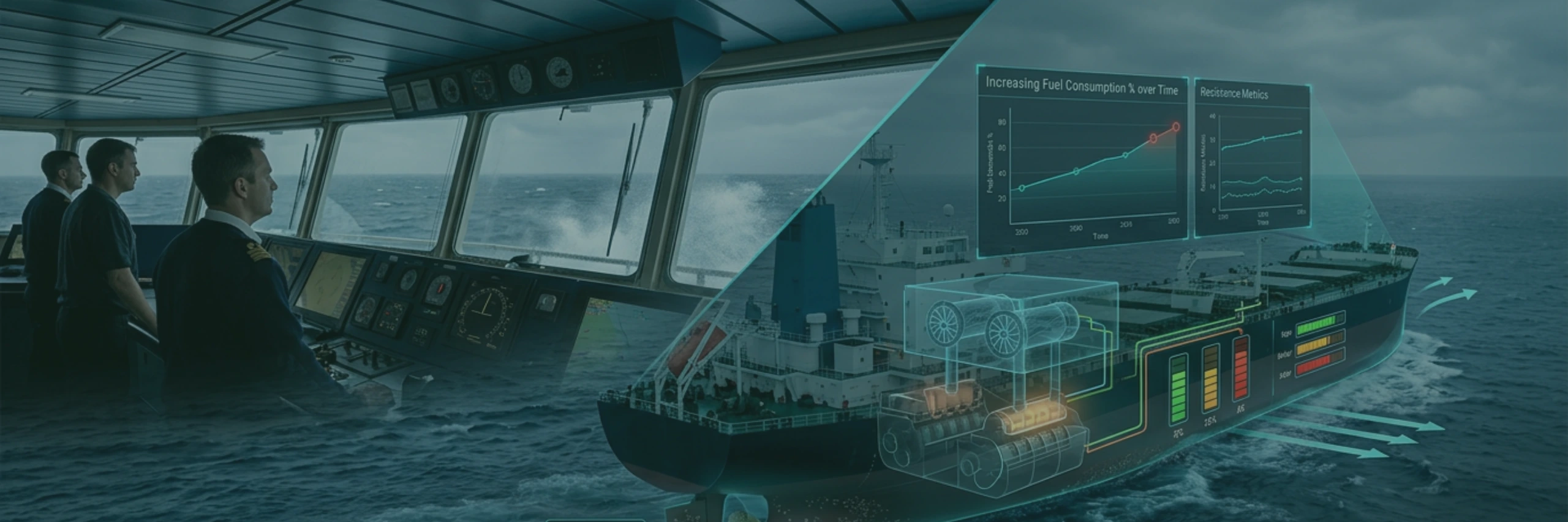
One of our biggest issues is how vessel performance loss actually shows up in real-time operations. There is a common assumption that inefficiencies are obvious and immediate. In reality, they rarely are. They develop slowly. A slightly rougher hull increases resistance. A propeller loses a bit of its efficiency. Engine performance drifts. Voyages become marginally less optimal. Individually, these changes are easy to ignore. Collectively, they can drive ship fuel consumption up by several percentage points over time.
What makes this problem more challenging is that these losses rarely trigger attention. There is no single moment where something clearly breaks. Instead, inefficiency becomes gradual and normalized. By the time someone notices and starts asking questions, the fuel has already been consumed and the emissions have already been produced. This is where a significant portion of hidden fuel loss sits, unsupervised.
Data Without Insight Is Not Performance Management
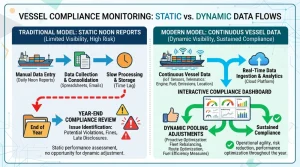
At the same time, the industry often points to data as the solution. While it is true that modern vessels generate more operational data than ever before, having data is not the same as understanding vessel performance optimisation . Most organisations are not struggling because they lack data. They are struggling because they lack clarity. Collecting information is relatively easy. Turning it into meaningful insight that drives decisions is much harder.
In many cases, data creates a false sense of control. Reports are generated, dashboards are built, but the fundamental question remains unanswered: what actually drives a vessel’s performance, and where are we losing energy efficiency ? What the industry needs is not more data, but clear, continuous insight into how vessels behave and why.
Decarbonisation Is an Operational Discipline, Not Just a Compliance Target
This is where we believe that maritime decarbonisation needs to be reframed. It is often treated as a compliance-driven challenge, shaped by regulation and future targets. But in practice, shipping decarbonisation is an operational discipline. It shows up in the everyday decisions made both onshore and offshore. Speed choices. Voyage optimisation . Trim optimisation. Hull maintenance. Machinery performance. None of these are new ideas, and none depend on future technology. Yet they are still not consistently executed at the level they need to be.
While meeting regulatory requirements is indeed necessary, it should not define ambition. If ship decarbonisation becomes nothing more than a compliance exercise, we risk missing a much larger opportunity. This is ultimately about operating vessels more intelligently — moving from reactive thinking to proactive fleet performance management , and from raw data to real understanding.
The Efficiency Gains Are Already Here — Within the Existing Fleet
What stands out is that many of the most meaningful gains are already within our reach. They do not require waiting for new fuels or large capital investments. They come from attention to detail, better visibility, and consistent operational efficiency in shipping. Fuel savings, carbon emissions reduction , and cost improvements are available today, even within vessels that have been running for years.
The industry is right to invest in the future of sustainable shipping. But it should not do so at the expense of the present. Real progress will come from balancing both. We need to continue innovating for tomorrow while becoming far more effective at operating today’s vessels through better vessel performance optimisation and smarter maritime fuel management . The opportunity is already here; the question is whether we are willing to focus on it.