Media Room
A New Age of Execution in Maritime: Insights from SMM Hamburg 2026
By Anil Jacob, Managing Director, OceanOpt

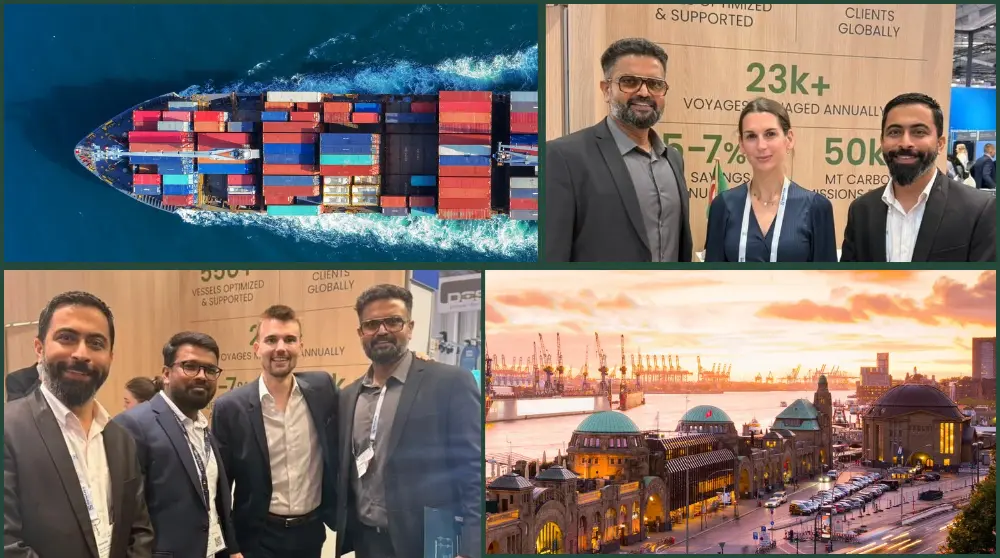
SMM Hamburg 2026 highlighted a significant shift in the maritime industry: the conversation is moving from understanding change to executing against it. Across discussions around maritime compliance, decarbonization, trusted data, artificial intelligence and energy efficiency, one theme emerged clearly — shipping companies are increasingly focused on turning regulation and technology into measurable operational and commercial outcomes.
After four days at SMM Hamburg 2026, one observation stayed with me more than any discussion about fuels, regulations or technology. The industry’s biggest challenge currently is no longer understanding change. In many of the conversations I had throughout the week, the focus had shifted toward something more practical: how to execute effectively in an increasingly complicated and uncertain operating environment.
When more than 50,000 maritime professionals and 2,300 exhibiting companies gather in one place, patterns become easier to spot. What emerged from Hamburg was not a consensus on the future; uncertainty remains high. The pace of regulation, regional policy differences, fuel availability, carbon costs and technology adoption continue to create multiple possible futures. The companies that appeared most confident were not necessarily those making the biggest bets. They were the ones building strategies capable of performing under different scenarios.
Maritime Compliance Is Becoming a Commercial Discipline
A few years ago, discussions around environmental regulations were largely centred on preparedness. Companies wanted to understand the rules, assess exposure and establish compliance processes. At SMM Hamburg 2026, many conversations appeared to reflect a different stage of maturity. Discussions increasingly focused on commercial risk allocation, compliance economics, contract structures, pooling mechanisms and long-term regulatory positioning.
Regulations such as EU ETS and FuelEU Maritime are increasingly being viewed not simply as reporting requirements, but as factors with direct commercial implications. Several fellow participants noted that compliance itself is no longer the primary challenge. The obligations behind compliance and regulation are now better understood. The more pressing question is how organizations manage the growing workload while continuing to improve operational and commercial performance.
As a result, the competitive advantage appears to be shifting toward organizations that can interpret regulatory requirements, understand their business implications and make better decisions because of them.
In other words, the question is no longer simply: “Are we compliant?” It is increasingly becoming: “Are we using compliance insights to make better commercial decisions?”
Why Trusted Maritime Data Is Becoming Critical Infrastructure
One topic surfaced repeatedly across discussions involving owners, operators, classification societies, regulators and technology providers: data. More specifically, trusted data.
Efforts led by organizations including BIMCO, DNV, RINA, Bureau Veritas, ClassNK and ABS to establish common frameworks for maritime emissions data exchange reflect a growing recognition that fragmented data creates friction in both compliance and commercial decision-making.
What I found particularly interesting was that these discussions were about both standards and trust. Standards create consistency, but trust creates action. Organizations need confidence that the information driving emissions reporting, FuelEU pooling arrangements, carbon accounting, performance optimization and charterparty settlements is accurate and reliable.
Without that confidence, time is spent reconciling data instead of making decisions. The maritime industry has traditionally viewed ports, vessels and trade routes as critical infrastructure. High-quality operational data must also begin to be viewed in the same manner.
AI and Digitalization in Shipping: From Hype to Operational Results
Another notable shift was the tone of discussions surrounding digitalization and artificial intelligence. For several years, maritime conferences have featured ambitious conversations about AI, automation and digital transformation. The enthusiasm remains, but many of the discussions I encountered were accompanied by a greater level of scrutiny.
There appears to be a growing emphasis on implementation and operational deployment. Companies were less interested in future possibilities and more interested in understanding how existing technologies can deliver results today. Operators were less interested in technological sophistication for its own sake and more interested in measurable return on investment, operational efficiency and decision support.
The question was rarely: “What can AI do?” Instead, it was: “What decision does it improve?”
This distinction matters because it signals a maturing market. Technology is increasingly being evaluated on outcomes rather than potential alone.
Many organizations already have access to significant amounts of software and operational data. The challenge is often not acquiring more technology, but interpreting information effectively and turning it into operational and commercial decisions. In that context, domain expertise, advisory support and decision-making frameworks can be just as important as the underlying technology itself.
Energy Efficiency and Operational Performance in Shipping
There was also a noticeable sense of pragmatism across many conversations. Shipping currently operates against a backdrop of geopolitical uncertainty, evolving regulations, security concerns and changing energy markets. Yet despite this uncertainty, companies continue to invest in solutions that demonstrate a capability to deliver measurable value.
This reality was especially reflected in the new Energy Efficiency Hub, where companies showcased practical approaches to reducing fuel consumption and emissions today. What stood out was not the promise of future benefits, but the emphasis on deployment and immediate impact.
Regardless of how regulations evolve or which fuels ultimately dominate, efficiency remains one of the few priorities that is relevant across nearly every operating scenario. For many operators, efficiency improvements can provide both environmental and commercial benefits. However, the value of any investment ultimately depends on vessel suitability, operating conditions, implementation costs and expected payback periods.
The Future of Maritime Strategy: Better Execution and Decision-Making
My strongest takeaway from Hamburg was not that the industry has reached a consensus on every challenge ahead. Many organizations appear to be spending less time debating whether change is necessary and more time discussing how to navigate it effectively. The conversation is becoming increasingly focused on execution.
The maritime sector’s next competitive advantage may not come from having more data, deploying more software or complying faster than competitors. It is more likely to come from the ability to connect regulation, operations, commercial strategy and technology into a coherent decision-making process.
The organizations that succeed over the next decade will be those that can transform trusted data into insight, regulatory requirements into commercial strategy and technology investments into measurable business outcomes.
That was my takeaway from SMM Hamburg 2026. The challenge facing the industry is no longer understanding change. It is executing within it.
3 Practical Actions for Maritime Leaders in 2026
- Accelerate energy-efficiency initiatives across the fleet, focusing on measures that can deliver value under multiple future scenarios.
- Evaluate compliance, fuel and technology options through structured business cases that combine commercial, operational and regulatory considerations.
- Adopt scenario-based fleet planning to test fuel and technology strategies against different regulatory, market and infrastructure outcomes.