Media Room

Insights from SeaJapan, Imabari Owner Seminar, and Singapore Maritime Week
By Anil Jacob, Managing Director, OceanOpt
The Conversation Has Already Changed
Across three major maritime events this spring, Sea Japan in Tokyo, the Imabari Owner Seminar, and Singapore Maritime Week, one shift in industry thinking was impossible to miss: decarbonization is no longer a compliance conversation. It’s a commercial one.
The tone has moved on. Shipowners, operators, and charterers are no longer debating whether to act on emissions. They are asking what acting on emissions actually delivers — in cost savings, risk reduction, and competitive positioning.
There is growing fatigue with fragmented reporting tools and compliance dashboards that produce little actionable value. In their place, the more commercially astute operators are building operational readiness now — not scrambling when the next regulatory inflection point arrives. The companies distinguishing between near-term regulatory pressures and longer-term structural shifts are already planning with that clarity.
This doesn’t signal a retreat from sustainability. It signals maturity.
Regulation: Directionally Clear, Practically Uncertain
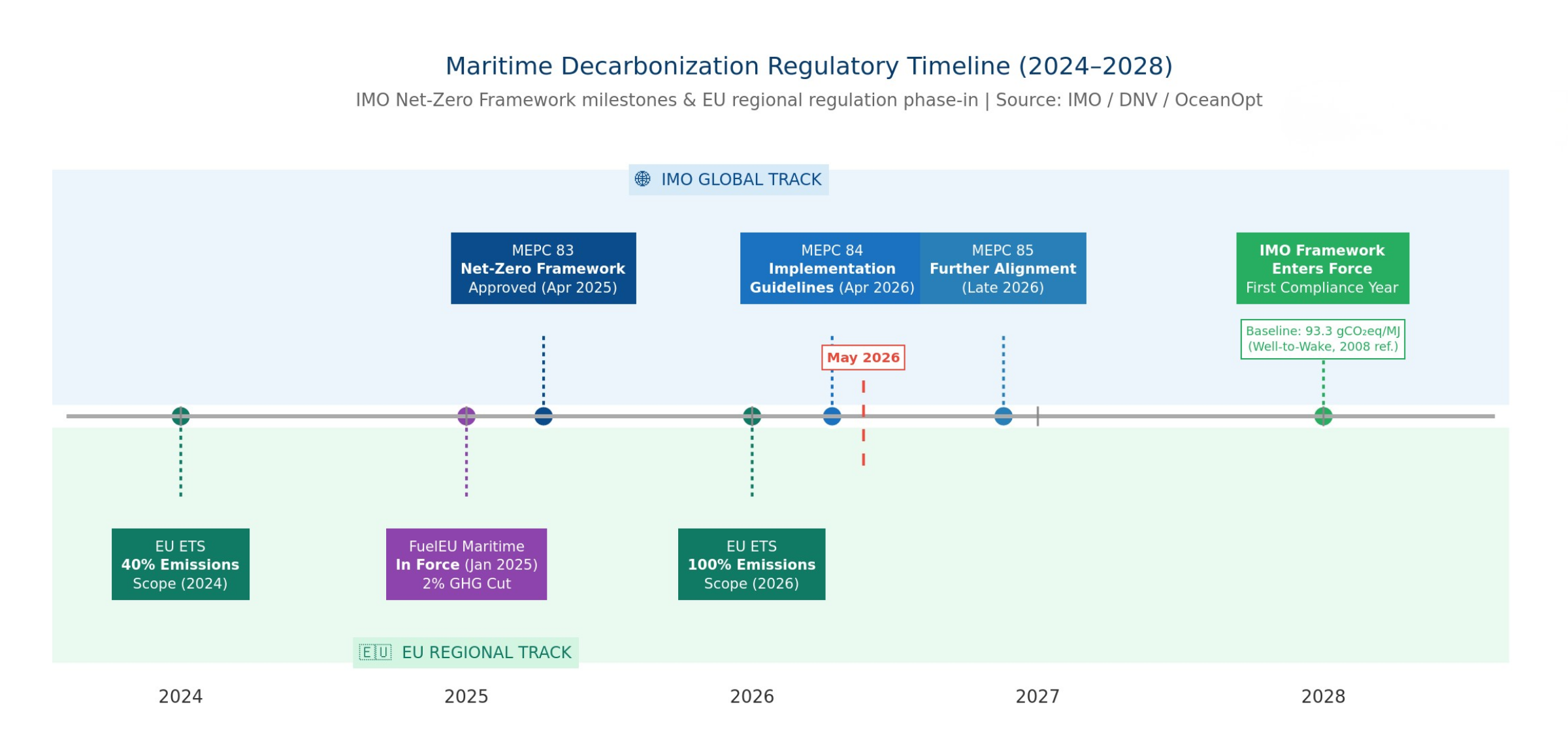
The IMO Net-Zero Framework remains a landmark development. Agreed at MEPC 83 in April 2025, it introduces a global structure combining emissions intensity limits with a greenhouse gas pricing mechanism, applying to vessels above 5,000 GT from 2028. But the political reality is more complex.
MEPC 84 in April 2026 unfolded as though the failed extraordinary session of October 2025 hadn’t happened. The same geopolitical fault lines persisted, and no real consensus on adoption emerged. With MEPC 85 scheduled for late 2026, there is little reason to expect a different outcome. Regulatory certainty isn’t getting closer — the window is simply moving.
Regional regulation, however, is already active. The EU ETS now applies to shipping, and FuelEU Maritime is in force. The result is a fragmented but real compliance landscape. Forward-looking operators see this as a planning horizon, not a barrier, and are building the data and operational foundations that will matter when global alignment arrives.
For maritime technology providers, the implication is direct: value must be demonstrated in current financial terms, not future compliance scenarios.
From Emissions Tracking to Financial Intelligence
One of the most important conceptual shifts discussed across all three events is this: “emissions management” alone no longer resonates at the level where capital decisions are made.
What is emerging instead are two stronger, more commercially compelling positions:
- Emissions optimization and management — emphasizing immediate operational efficiency gains
- A financial and risk intelligence platform — translating emissions performance directly into P&L outcomes
This distinction matters significantly. Operators are not motivated by dashboards. They respond to quantified impact: fuel cost savings, avoided EU ETS penalties, and reduced CII-related commercial exposure.
A tool that visualizes performance is useful. A system that translates that performance into financial outcomes is actionable.
In today’s environment of uncertain regulatory timelines, the commercial argument must lead. The most effective positioning is straightforward: “We improve your financial performance and reduce your risk — compliance follows from that.”
Cost savings are always relevant. Compliance alone is not.
AI in Maritime: Interest Is High. Readiness is Uneven
Artificial intelligence dominated attention at Sea Japan 2026. Sessions were packed, and industry expectations are clear — AI is seen as central to the next operational phase of maritime management. But a significant gap remains between ambition and execution. The challenge is not access to AI tools. It is the quality and structure of the underlying data that those tools depend on.
One point came up repeatedly across industry discussions:
“AI cannot compensate for poor data.”
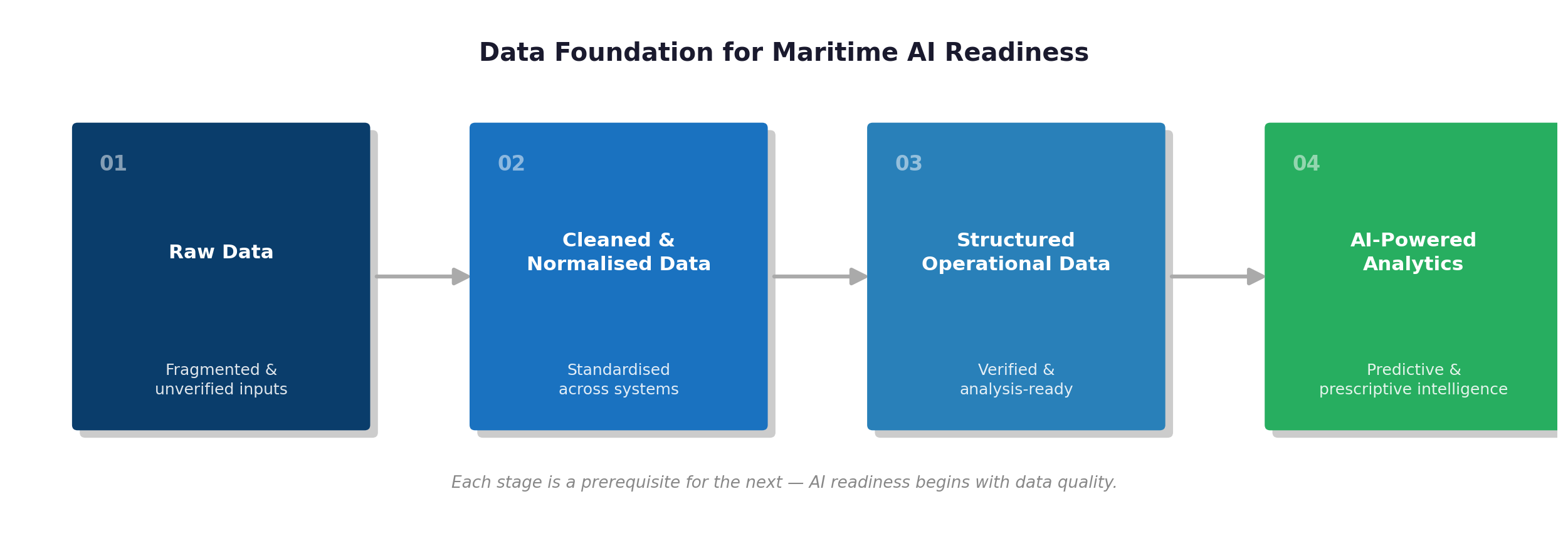
Maritime operational data is fragmented — spread across vessels, systems, and stakeholders with limited standardization. This makes consolidation and reliable analytics difficult. As a result, data quality is the real differentiator today, not AI capability itself. Operators with structured, verified, and continuously updated datasets can deploy advanced analytics effectively. Those without cannot skip steps — the groundwork still needs to be built.
The most valuable near-term service is therefore data hygiene: cleaning, normalising, and validating operational and emissions data. This work delivers immediate operational benefits and is the prerequisite for any meaningful AI deployment.
The companies that will win the AI era in maritime are those already sitting on large volumes of structured, verified data. That is a current advantage — and it compounds over time.
The Operator Gap: A Significant Market Opportunity
A consistent structural signal emerged across all events: most maritime platforms are designed around ship owners and managers, not operators and charterers.
This reflects how compliance responsibilities are legally organised. But commercial operations follow a different logic. Charterers and operators — those managing voyages and optimising commercial performance — are not fully served by current solutions. Areas such as charter party compliance, voyage-level emissions attribution, and commercial outcome optimisation remain underdeveloped across the market. This gap is widely recognised but not yet addressed at scale. Even at Sea Japan, where attendees skewed heavily toward owners and managers, the few operator-side participants present were focused on exposure management rather than detailed voyage optimisation.
The opportunity is clear:
- Solutions that bridge technical vessel performance with commercial decision-making
- Platforms that serve both ship-side operations and shore-side commercial teams
- Tools that align emissions, performance, and financial data across all stakeholders
This is not a niche. It is an underpenetrated segment with significant global relevance.
Japan: A Distinct Market with a Proven Entry Pattern
Japan requires a deliberate approach. Its maritime sector combines large, globally competitive players with a long tail of smaller shipowners — many managing only a handful of vessels — with significantly varying investment capacity.
Two dynamics stood out clearly at both Sea Japan and Imabari.
1. Trust Drives Adoption
Technology decisions in Japan are not made through feature comparisons alone. They are shaped by trusted references. A single successful deployment can unlock multiple introductions. This was visible in real time at the Imabari Owner Seminar, where one positive interaction led directly to another prospect engagement.
2. Platforms Come First
Japanese owners prefer solutions they can adopt and operate independently. Service is important — but only once product capability is proven. The practical market entry strategy that works reflects this:
- Start with smaller, accessible owners
- Deliver high-quality, measurable outcomes
- Build genuine advocacy
- Let referrals compound
Once trust is established in the Japanese maritime market, growth accelerates quickly.
What the Spring 2026 Maritime Events Really Tell Us
Taken together, the signals from Tokyo, Imabari, and Singapore are consistent and clear. Global regulation is moving — but not predictably. Regional regimes are already shaping commercial decisions. Operators are prioritising operational flexibility over compliance certainty. Data quality is becoming the foundation for both current efficiency and future AI capability. And decarbonization is not in question — how it pays its way is.
The maritime industry is no longer persuaded by long-term compliance arguments alone. It expects a clear link to financial performance today. That link already exists:
- Fuel efficiency directly affects operating margins
- Emissions exposure influences voyage costs and asset values
- Data-driven operations improve competitiveness and commercial resilience
The companies that succeed in this environment will be those that express decarbonization in those terms — clearly, quantitatively, and immediately.
At OceanOpt, this has always been our approach: bringing together performance management, voyage economics, compliance execution, and commercial decision support into a single operating layer. We’re not waiting for regulatory pressure to force change. We are already ready.

Anil Jacob, Managing Director OceanOpt