Media Room

Beyond the April 30th Deadline
By Socrates Pilavakis, Commercial Emission Compliance Manager, OceanOpt
The April 30th deadline for formalizing FuelEU Maritime pools has passed. For ship managers, this wasn’t just another regulatory checkpoint; it was the industry’s first true Carbon Transfer Window, separating those who were prepared from those who were not. The question driving boardroom conversations has permanently shifted. It is no longer just “Is the ship seaworthy?” It is: “Is the ship’s carbon balance solvent?“
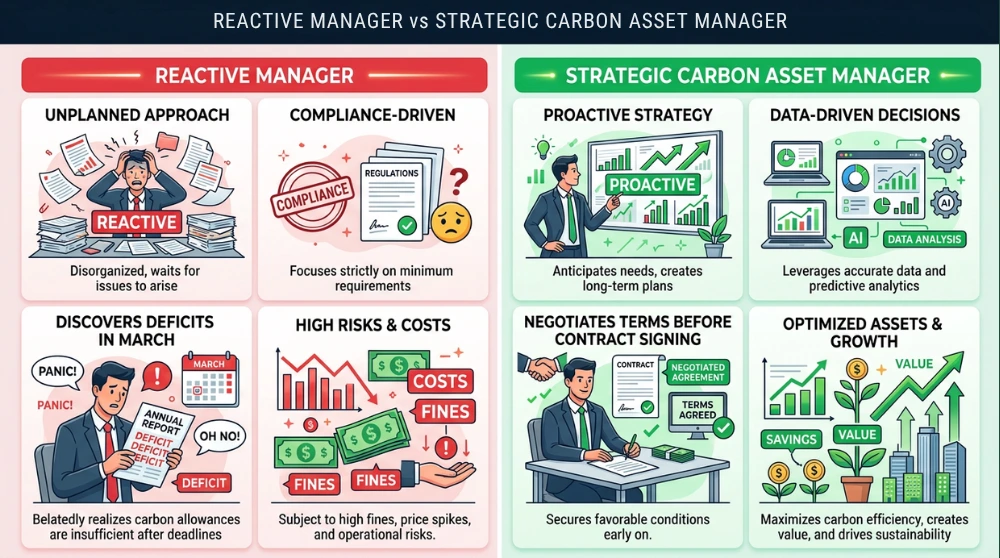
As vessels move between owners and managers, they carry what is effectively a shadow P&L, a compliance balance that can be either a commercial asset or a crippling liability. The ship managers leading in 2026 are those who have stopped acting as technical caretakers and started operating as Carbon Asset Managers.
From Technical Custodian to Compliance Underwriter
The traditional ship management model was built on fixed fees and technical KPIs. The EU regulatory framework has fundamentally disrupted that contract. Under the Document of Compliance (DoC) mandate, the ship manager is typically the legal “Company” responsible for FuelEU compliance, the entity that faces the regulator, and signs verification reports. It is legally liable for any penalties incurred.
When a manager onboards a vessel mid-year, they are effectively underwriting that vessel’s emissions history. A ship joining a fleet in July after six months of burning high-carbon-intensity HFO under a previous regime brings with it a compliance debt, whether or not the incoming manager was aware of it.
Commercial leadership today requires Emissions Due Diligence before any management contract is signed. By auditing an incoming vessel’s fuel consumption data during the pre-management phase, a manager can identify a compliance deficit, negotiate indemnity, or demand a surplus injection into the pool before taking on liability. This is the operational difference between a reactive service provider and a strategic partner.
The April 30th Hard Stop: What External Pooling Really Means
Internal pooling, aggregating compliance balances across a managed fleet, is the first line of defence. But external pooling, the trading of compliance balances between entirely different companies, is where commercial leadership is now being defined. The April 30th deadline was a hard stop with no exceptions. The FuelEU database closed for the 2025 reporting year, and any manager who failed to coordinate external pool partners or had data rejected during final verification lost their safety net entirely. The only remaining option is the FuelEU penalty, currently set at €2,400 per tonne of VLSFO-equivalent deficit.
Success in external pooling depended on three non-negotiable requirements:
- Verified Positive Balances: All balances had to be finalized in the THETIS-MRV system by the March 31st verification deadline. Projections alone are not sufficient and are not accepted.
- The Single-Verifier Rule: While individual ships can use different verifiers for annual reports, the entire pool must be reconciled with a single verifier for the final compliance allocation.
- Administrative KYC: Surplus transfers require multi-party approval. A single administrative delay or an unvetted counterparty can collapse an entire pool at the point of submission.
The Data Integrity Gap: Why Noon Reports Are No Longer Enough
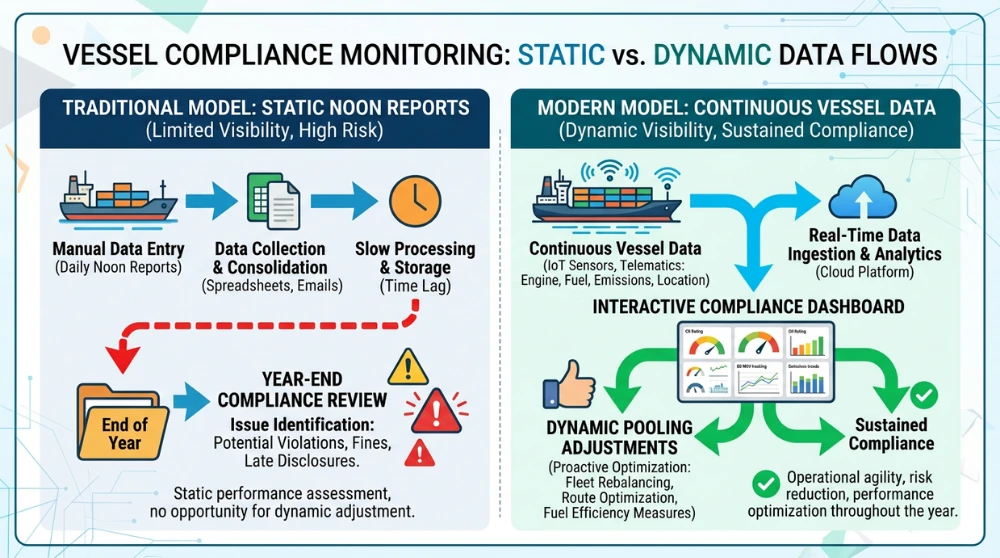
The most significant threat to a successful Pooling Month is not regulatory complexity, but data quality. For decades, the industry has relied on Noon Reports: manual log entries that are inherently prone to human error. In an environment where the penalty is €2,400 per tonne, a 2% recording error is not a minor discrepancy. It is a direct financial liability.
A pool built on flawed data delivers a false sense of security. If a verifier catches a discrepancy in March, a position that appeared to show a 500-tonne surplus can instantly become a 100-tonne deficit, with no time to correct it.
The answer is continuous, automated monitoring. Managers who know their compliance position every day of the year, not just in March, can make dynamic adjustments throughout the operating year: changing vessel speeds, optimizing fuel blends, or adjusting trade patterns in November to ensure the April pool closes exactly where it needs to be.
Internal Pool Architecture: Distributing Green Alpha Across the Fleet
For managers operating large fleets, the internal pool remains the core compliance strategy. By aggregating the compliance balances of every managed vessel, managers create a mini market within their own fleet, one that allows the Green Alpha generated by the most efficient vessels to be distributed across those with higher emissions intensity.
Effective internal pool management requires two specific analytical capabilities:
- Surplus Arbitrage: Should a manager deploy their fleet surplus now, or bank it against future compliance periods? With GHG intensity targets increasing to 6% by 2030, the financial value of a carbon surplus compounds over time. Multi-year modelling is essential for making this decision accurately.
- Mid-Year Correction: Predictive modelling can identify the September Slump, the point where a change in trade pattern or hull fouling begins to threaten the pool’s year-end balance, months before it becomes a crisis that cannot be corrected within the reporting window.
Fuelling for Profit, Not Just Compliance
In 2026, fuel strategy is an arbitrage decision, not just an operational one. The compliance break-even calculation, the exact point at which the cost of biofuel becomes cheaper than the combined cost of HSFO plus FuelEU penalties, is now a core financial tool for any commercially minded ship manager.
Three practical decisions define the strategic approach:
- The Bio-Blend Sweet Spot: Biofuel procurement is logistically expensive. The optimal position is not maximum biofuel use; it is the specific quantity and grade required to hit the compliance target without over-complying and absorbing unnecessary cost.
- Pool or Bank: With the 2030 GHG reduction target of 6% approaching, forward-curve modelling now determines whether deploying surplus today or banking it for future periods delivers better financial returns.
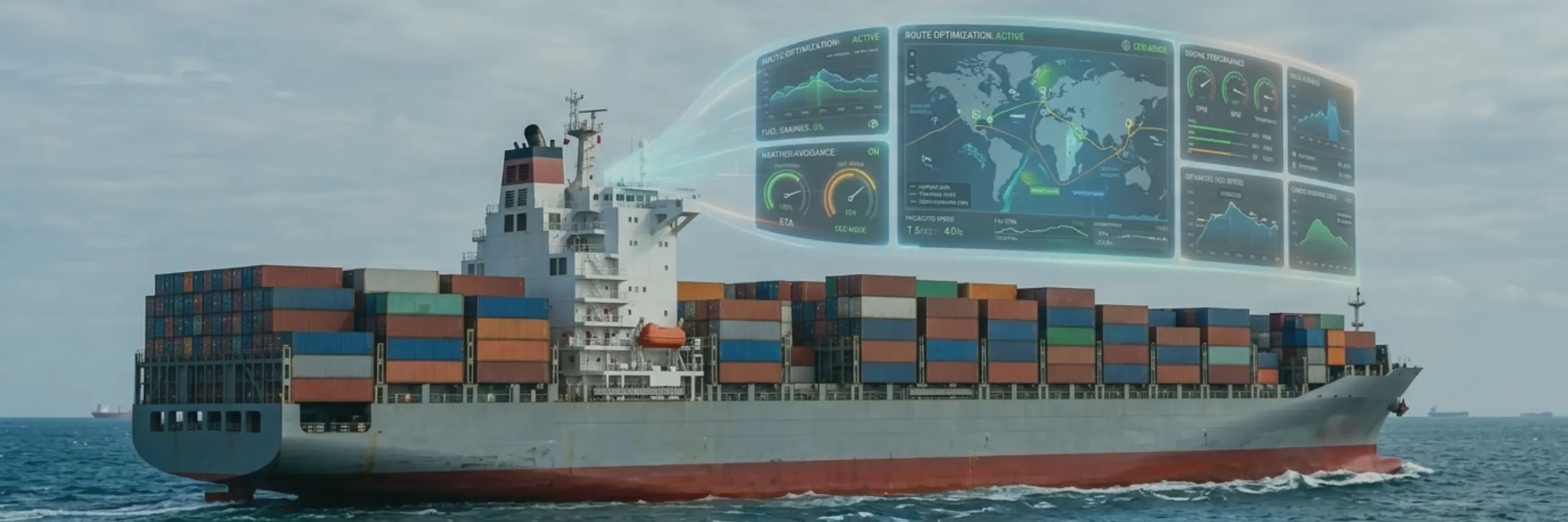
- Real-Time Position Awareness: Managers with live compliance dashboards do not guess at year-end positions. They optimise continuously, using actual operational data rather than projections.
The Divide Is Widening
The ship management sector is splitting into two distinct groups. On one side are managers who spent April scrambling to fix data gaps, chase verification approvals, and hope their external pool partners remained solvent. On the other hand are the Architects, those who had already built their compliance position over the preceding twelve months.
The Architects can walk into a meeting with a Tier-1 owner and demonstrate, with verified data, how they reduced regulatory OPEX by 60–65% through strategic pooling. That is not a pitch. That is a commercial differentiator backed by numbers.
In the era of FuelEU and EU ETS, the ship managers who will lead the transition have already reached one conclusion: the most valuable asset on a vessel is no longer its steel. It is the data that flows from it.